Diagnostic Criteria For Posttraumatic Stress Disorder

PTSD was recognized in the early 1970s and formalized in 1980, largely the result of work by and with US veterans of the war in Vietnam. Many people who think about these things consider this recognition to be a turning point in psychological diagnosis. In fact, one way of thinking about psychological diagnosis is that most of what we now call Mental Disorders are basically variants of PTSD–the ways that different people respond to different traumas. If the committee working on version V of the DSM were to humor us, they might rename the tome The North American and European Catalog of Post-Traumatic Stress Behavior Patterns Plus a Few Other Human Difficulties.

Here’s a fuzzy map from the wikipedia article, showing PTSD rates. The darker the red, the more PTSD, and the lighter the yellow, the less:

Here are the criteria, word for word, from the Diagnostic and Statistical Manual of Mental Disorders IV-TR, pages 467 and 468:

Diagnostic criteria for 309.81 Posttraumatic Stress Disorder

A. The person has been exposed to a traumatic event in which both of the following were present:

(1) the person experienced, witnessed, or was confronted with an event or events that involved actual or threatened death or serious injury, or a threat to the physical integrity of self or others

(2) the person’s response involved intense fear, helplessness, or horror. Note: In children, this may be expressed instead by disorganized or agitated behavior

B. The traumatic event is persistently reexperienced in one (or more) of the following ways:

(1) recurrent and intrusive distressing recollections of the event, including images, thoughts, or perceptions. Note: In young children, repetitive play may occur in which themes or aspects of the trauma are expressed.

(2) recurrent distressing dreams of the event. Note: In children, there may be frightening dreams without recognizable content.

(3) acting or feeling as if the traumatic event were recurring (includes a sense of reliving the experience, illusions, hallucinations, and dissociative flashback episodes, including those that occur on awakening or when intoxicated). Note: In young children, trauma-specific reenactment may occur.

(4) intense psychological distress at exposure to internal or external cues that symbolize or resemble an aspect of the traumatic event

(5) physiological reactivity on exposure to internal or external cues that symbolize or resemble an aspect of the traumatic event

C. Persistent avoidance of stimuli associated with the trauma and numbing of general responsiveness (not present before the trauma), as indicated by three (or More ) of the following:

(1) efforts to avoid thoughts, feelings, or conversations associated with the trauma

(2) efforts to avoid activities, places, or people that arouse recollections of the trauma

(3) inability to recall an important aspect of the trauma

(4) markedly diminished interest or participation in significant activities

(5) feeling of detachment or estrangement from others

(6) restricted range of affect (e.g., unable to have loving feelings)

(7) sense of a foreshortened future (e.g., does not expect to have a career, marriage, children, or a normal life span)

D. Persistent symptoms of increased arousal (not present before trauma), as indicated by two (or more) of the following:

(1) difficulty falling or staying asleep

(2) irritability or outbursts of anger

(3) difficulty concentrating

(4) hypervigilance

(5) exaggerated startle response

E. Duration of the disturbance (symptoms in Criteria B, C, and D) is more than 1 month.

F. The distrubance causes clinically significant distress or impairment in social, occupational, or other important areas of functioning.

Specify if:

Acute: if duration of symptoms is less than 3 months

Chronic: if duration of symptoms is 3 months or more

Specify if:

With Delayed Onset: if onset of symptoms is at least 6 months after the stressor

(First published May 16, 2011 on Nathen’s Miraculous Escape.)

Common Factors and the Pinhole Fallacy

I am writing about a logical fallacy that I have been calling a “pinhole fallacy” and I would like to know what it is actually called.

The general form is this: First, a lot of empirically generated data is summarized into a few ideas, then those few ideas are then used to generate a lot of ideas which are assumed to be empirically generated because of their apparent origin in empirically derived data.

I’ve actually been calling it “family therapy’s Lambert-pinhole common factors fallacy” because I came across it in this form (greatly simplified, of course):  There has been a lot of research into what effective (individual-based) therapeutic modalities have in common. As far as I can tell, this research is pretty good, on the whole, though it has not come close to showing anything like causation, mediation, or mechanisms of change in therapy.  A guy named Lambert wrote a paper about this evidence, summarizing all of the many elements common to therapy modalities into four broad categories: the therapeutic relationship, model-specific factors, hope and expectancy on the part of the client, and extratherapeutic factors. Many writers in family therapy has gone on to take his summary as new data, creating new models of therapy based on the four-common-factor idea, and apparently thinking of this common-factor model as empirically generated and supported.

This process relies on a “hasty generalization” fallacy, and also a “post hoc” fallacy, but it seems to me that it should have its own name. What is it, logicians?

(First published as “Know Your Logic? Help Me Out!”  May 7, 2011, on Nathen’s Miraculous Escape.)

How Writing My FCP is Like Shoveling Gravel

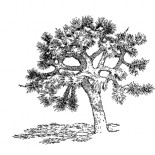
The first time I worked for money outside of my parents’ home I was 12 years old.  The Morongo Basin Ambulance Association hired me and my best friend John to move a pile of gravel from one spot to another with shovels.  I think we got paid a dollar an hour.  It was summer in Joshua Tree, and so around 100 F (maybe 45 C for Canadians), and the pile of gravel was huge.  After a couple hours I still could not see that we had made a dent in the pile and I complained that we would never finish this job.

John was bigger and stronger than me and remained more in touch with his logical faculties.  He said, “It doesn’t matter if we can’t see a dent.  As long as we keep shoveling gravel, we know that we are making progress, and that we will eventually be done.”

It is hard to argue against that, so I am thinking of John while I am working on my Formal Client Presentation, which is the Master’s thesis of my Couples and Family Therapy program: a monster paper incorporating all of the theory and practice that we have learned in two years, plus a presentation of video of me using all of that during therapy sessions.  It is going so slowly that each time I come back to it, I feel as if I had made no progress. But I know as long as I am typing new words each time I must be making progress, and that means eventually I will be done.

Thanks John!

(First published April 27, 2011 on Nathen’s Miraculous Escape.)

Synesthesia

My friend Tilke sent me a link to this short film depicting synesthesia, writing “This is what it’s really like.”

Folks with synesthesia experience what those without it might call a mixup of the senses–seeing sounds, feeling colors, that kind of thing. The most famous way synesthesia shows up is with the alphabet: A synesthete might see letters in different colors. It’s not that they associate colors with letters, they will actually see an “N” as inherently brown, for example, or an “E” as red. Numbers can have colors, too. Imagine how different your experience of reading or math would be if words and equations had color schemes!

At first I was fascinated by synesthesia in terms of what might cause it–maybe it’s the result of incomplete synaptic pruning, for example. In a lecture by Dr. Ed Awh in his Cognitive Psychology class a few years ago, though, I realized that synesthesia is more like a super power than a problem. Here’s a slide from the lecture:


Difficult, slow search for most of us, because we have to look at each digit to determine whether it’s a 2 or a 5. A synesthete with colored numbers does not have to do this, because color is what cognitive psychologists call a primary-search quality. Differences in color jump out at you. Imagine the same field of 2s and 5s, except the 2s were blue and the 5s were red. You could pick out the 2s immediately, like I saw Tilke do. A superpower!

(First published April 10, 2011 on Nathen’s Miraculous Escape.)

DSM-IV-TR Diagnostic Criteria for Asperger’s Disorder

There is quite a bit of controversy about it, but it looks as if Asperger’s Disorder will only be around for a couple more years. This diagnosis will probably get the axe in the upcoming DSM-V, when it arrives, subsumed into the so-called Autism Spectrum. It will be interesting to watch how a change in language will change how we think about a certain constellation of behaviors. If you’re interested, I have a link here to the proposed changes to the DSM.

Please read my disclaimer here about diagnosing yourself or anyone you know. The short version is, you can’t do it.

And, for the time being, here are the diagnostic criteria, word-for-word from the Diagnostic and Statistical Manual of Mental Disorders, Fourth Edition, Text Revision, page 84. As with Autistic Disorder, note the absence of qualities we may think of as common in Asperger’s Disorder, such as being picky about food or other things, being sensitive to things like noise or texture, any visual processing abnormalities such as non-susceptibility to visual illusion, being easily upset, self-harming behaviors, high IQ or “splinter skills.” None of these are considered in the diagnosis.

Diagnostic criteria for 299.80 Asperger’s Disorder

A. Qualitative impairment in social interaction, as manifested by at least two of the following:

(1) marked impairment in the use of multiple nonverbal behaviors such as eye-to-eye gaze, facial expression, body postures, and gestures to regulate social interaction

(2) failure to develop peer relationships appropriate to developmental level

(3) a lack of spontaneous seeking to share enjoyment, interests, or achievements with other people (e.g., by a lack of showing, bringing, or pointing out objects of interest to other people)

(4) lack of social or emotional reciprocity

B. Restricted repetitive and stereotyped patterns of behavior, interests, and activities, as manifested by at least one of the following:

(1) encompassing preoccupation with one or more stereotyped and restricted patterns of interest that is abnormal either in intensity or focus

(2) apparently inflexible adherence to specific, nonfunctional routines or rituals

(3) stereotyped and repetitive motor mannerisms (e.g., hand or finger flapping or twisting, or complex whole-body movements)

(4) persistent preoccupation with parts of objects

C. The disturbance causes clinically significant impairment in social, occupational, or other important areas of functioning.

D. There is no clinically significant general delay in language (e.g., single words used by age 2 years, communicative phrases used by age 3 years).

E. There is no clinically significant delay in cognitive development or in the development of age-appropriate self-help skill, adaptive behavior (other than in social interaction), and curiosity about the environment in childhood.

F. Criteria are not met for another specific Pervasive Developmental Disorder or Schizophrenia.

[First published on Nathen’s Miraculous Escape, April 6, 2011.]

DSM-IV-TR Diagnostic Criteria for Autistic Disorder

Please remember that I post diagnostic criteria here because it is interesting to know what kinds of behaviors can get you what kinds of diagnoses, not so you can diagnose yourself, anyone in your family, or any of your friends. You just cannot be objective enough and it often leads to people walking around thinking they have Mental Disorders that they do not have. This is especially not good if that person is a child.

This may be especially true for Autism-Spectrum Disorders, which require a team of experts collaborating with the family to make a good diagnosis, including ideally a developmental pediatrician, a psychologist, a social worker, a speech language specialist, an occupational therapist, and a physical therapist. Also maybe a family advocate and an early interventionist.  And that’s just for a medical diagnosis. It varies by state, but often educational eligibility requires, additionally, a school psychologist, a behavior specialist, and an autism specialist.

Notice in the criteria below that diagnosis is made based on social problems, language problems, and repetitive/stereotyped behaviors. Other qualities that we may associate with Autism, such as pickiness about food or other things, sensitivity to noise or textures, visual processing problems, being easily upset, self-harming behaviors, and “splinter skills” are not part of a diagnosis for Autistic Disorder. Even with extreme versions of those qualities, you do not an AD diagnosis without fitting the criteria below.

And here are the criteria, word for word from the Diagnostic and Statistical Manual of Mental Disorders, Fourth Edition, Text Revision (p. 75):

Diagnostic criteria for 299.00 Autistic Disorder

A. A total of six (or more) items from (1), (2), and (3), with at least two from (1), and one each from (2) and (3):

(1) qualitative impairment in social interaction, as manifested by at least two of the following:

(a) marked impairment in the use of multiple nonverbal behaviors such as eye-to-eye gaze, facial expression, body postures, and gestures to regulate social interaction.

(b) failure to develop peer relationships appropriate to developmental level

(c) a lack of spontaneous seeking to share enjoyment, interests, or achievements with other people (e.g., by a lack of showing, bringing, or pointing out objects of interest)

(d) lack of social or emotional reciprocity

(2) qualitative impairments in communication as manifested by at least one of the following:

(a) delay in, or total lack of, the development of spoken language (not accompanied by an attempt to compensate through alternative modes of communication such as gesture or mime)

(b) in individuals with adequate speech, marked impairment in the ability to initiate or sustain a conversation with others

(c) stereotyped and repetitive use of language or idiosyncratic language

(d) lack of varied, spontaneous make-believe play or social imitative play appropriate to developmental level

(3) restricted repetitive and stereotyped patterns of behavior, interests, and activities, as manifested by at least one of the following:

(a) encompassing preoccupation with one or more stereotyped and restricted patterns of interest that is abnormal either in intensity or focus

(b) apparently inflexible adherence to specific, nonfunctional routines or rituals

(c) stereotyped and repetitive motor mannerisms (e.g., hand or finger flapping or twisting, or complex whole-body movements)

(d) persistent preoccupation with parts of objects

B. Delays or abnormal functioning in at least one of the following areas, with onset prior to age 3 years: (1) social interaction, (2) language as used in social communication, or (3) symbolic or imaginative play.

C. The disturbance is not better accounted for by Rett’s Disorder or Childhood Disintegrative Disorder.

[First published on Nathen’s Miraculous Escape, April 4, 2011.]

Fake Drugs

These fake drug commercials are hilarious. Maybe it’s just that I have psych-meds “on the brain” because I’ve just finished a child-diagnosis class and reading Robert Whitaker’s Anatomy of an Epidemic.

Despondex

Havidol

Nexoriatin

[First published on Nathen’s Miraculous Escape, March 13, 2011.]

How To Make Your Hamster Depressed

How do you make your hamster depressed? Leave the TV on at night.

I didn’t even know that hamsters got depressed, but apparently they do, according to an articleby PsychCentral. One of the ways you can tell is that they start drinking less sugar water. “Scientists assume this occurs because they’re not getting as much pleasure from normally enjoyable activities.” If that is true, then the hamsters are experiencing anhedonia, which is one of the diagnostic criteria for depression.

The article was about an experiment in which scientists tested the effects of leaving a light on that was about as bright as a TV (5 lux) at night for some hamsters and turning the lights off for other hamsters. Not only did the TV-hamsters get depressed, but when the scientists cut up their brains, they found they had atrophied.

Does this apply to humans? Let’s check it out with sample size one: I prefer total darkness at night, too. The lights from neighbors’ houses shining into my room irritate me. Unfortunately, irritable mood is not one of the diagnostic criteria for depression unless you are a child or adolescent. Adults have to feel moods like “sad” or “empty” to qualify for a depressed mood in the DSM. Plus, my desire for sugar water increases when I’m depressed.

It looks like we’ll have to wait for some human trials of this experiment. Without the cutting-up-their-brains part.

[First published on Nathen’s Miraculous Escape, March 4, 2011.]

Husbands, Stop Rehearsing Distress-Maintaining Attributions

One of the ways that John Gottman says people talk themselves out of their marriages is “rehearsing distress-maintaining attributions” in between arguments. That is, instead of making up stories about how their troubles are passing and circumstantial, they make up stories about how their troubles have to do with permanent flaws in their partner’s character. Over time, this version of the story solidifies and they reinterpret the entire history of the relationship using that filter.

This is another of Gottman’s gendered findings; it is mostly a problem because the men (in heterosexual marriages, at least) do it. It’s a problem when women do it, too, they just don’t tend to as much.

The alternative to rehearsing distress-maintaining attributions is rehearsing relationship-enhancing attributions, and this is exactly what Gottman found that the people in marriages that ended up happy and stable did. It’s probably a good idea, then, to practice rehearsing relationship-enhancing attributions if you can. Try thinking about the strengths of your relationship, good times, things you are proud of, ways that current conflict is passing and circumstantial. If that is difficult to do, think instead about couples counseling.  If you want to keep your relationship, you probably need help.

[First published on Nathen’s Miraculous Escape, March 2, 2011.]